July 21, 2026
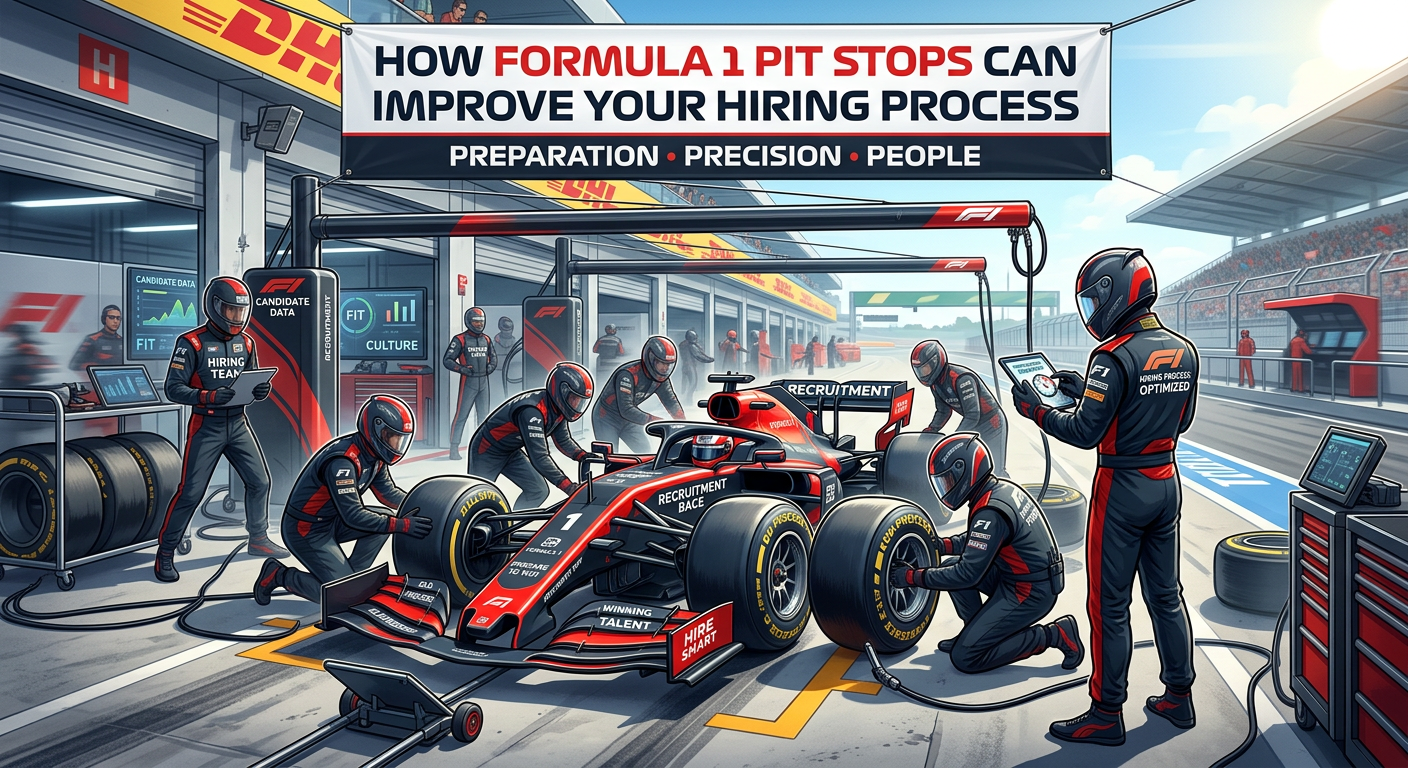
What Formula 1 Pit Stops Can Teach Us About Building a Better Hiring Process
Watch a Formula 1 pit stop and it's easy to think you're seeing speed.
In reality, you're seeing preparation.
The tyres are ready.
Every mechanic knows their position.
Every movement has been practised hundreds of times.
Nobody is making decisions in the moment because all the important decisions have already been made.
The pit stop might only last a couple of seconds.
The preparation lasts for weeks.
A great hiring process works exactly the same way.
When a business decides to recruit, there's often a flurry of activity.
A job description gets written.
Interview stages are discussed.
People start comparing notes on what they're looking for.
Someone asks whether the salary is competitive.
Someone else realises they're on annual leave for two weeks.
Before you've even spoken to a candidate, the process has already slowed down.
It isn't because anyone is doing a bad job.
It's because the preparation has only just started.
The businesses that consistently hire well don't necessarily move faster.
They're simply better prepared.
Before the role goes live, they've already agreed:
That preparation creates confidence.
Candidates know where they stand.
Hiring managers know what they're looking for.
The process feels organised instead of reactive.
Here's where the Formula 1 analogy becomes even more interesting.
The pit crew doesn't start preparing when the car enters the pit lane.
They've been preparing all season.
The same is true of specialist recruiters.
Clients see the shortlist.
They don't see the hundreds of conversations that came before it.
They see interviews being arranged.
They don't see years spent building relationships across the marketing industry.
They see an accepted offer.
They don't see the market mapping, salary benchmarking, career conversations and networking that made that introduction possible.
That's the invisible work.
It's why experienced recruitment consultants rarely start from zero.
One of the biggest misconceptions about recruitment is that recruiters simply find candidates.
Good recruiters do far more than that.
They're constantly building relationships.
Keeping up with changes in the market.
Understanding who's thriving in their role, who's feeling undervalued and who's open to the right opportunity.
They're learning which skills are becoming more valuable.
They're advising candidates long before those candidates become applicants.
So when a client needs to hire, the groundwork has already been done.
Just like a Formula 1 pit crew, the preparation happened before anyone was watching.
People often ask how to speed up their hiring process.
It's probably the wrong question.
A better question is:
How can we be better prepared before we start?
Preparation reduces uncertainty.
It leads to better interviews.
Clearer decisions.
A better candidate experience.
And ultimately, better hires.
The smoothest hiring processes aren't the ones where everyone rushes.
They're the ones where everyone knows exactly what they're trying to achieve.
Formula 1 teams don't deliver incredible pit stops because they work harder in those two seconds.
They deliver them because they've spent weeks preparing for them.
Hiring is no different.
If your recruitment process feels complicated, the answer probably isn't to move faster.
It's to prepare better.
Because when the groundwork is done properly, everything else tends to fall into place.
At Stonor, we believe hiring shouldn't feel risky.
Like a great Formula 1 pit stop, the best recruitment processes aren't built on rushing. They're built on preparation, clarity and confidence.
That's the difference between simply filling a vacancy and making the right hire.