September 7, 2026
We’ve noticed something happening more often in recruitment this year.
A candidate isn't desperately trying to escape their current job. They're doing well. Probably quite comfortable. But they've reached the point where they're ready for something new.
So they start looking.
They meet a business they genuinely like. The role is a step forward, the money works, they get on well with the people and, after a few interviews, both sides are pretty convinced.
An offer is made.
They accept.
Then the candidate has to do the one thing that makes the whole thing real.
They resign.
And suddenly the exciting new opportunity they've spent the last few weeks discussing is competing with something surprisingly powerful:
The safety of staying exactly where they are.
We’ve seen more candidates wrestle with this at Stonor over the past year, and we don’t think it’s simply a counteroffer problem.
We think there’s a confidence gap in the hiring market.
People are willing to look. They're willing to interview. They want progression and they're open to a better opportunity.
Actually leaving somewhere they know for somewhere they don't?
That feels like a much bigger decision at the moment.
The simple answer is that changing jobs feels riskier when confidence in the wider jobs market is low.
And confidence is definitely low.
The latest Office for National Statistics figures put UK vacancies at 707,000 for May to July 2026, down 2.7% on the previous year. There were around 2.5 unemployed people for every vacancy in April to June.
The CIPD's Summer 2026 Labour Market Outlook isn't exactly overflowing with optimism either. Its survey of more than 2,000 UK employers found employer confidence remains close to record lows outside the pandemic. Only 62% expect to recruit in the next three months, falling to 57% among private sector employers.
There are some encouraging signs.
The latest KPMG and REC Report on Jobs found permanent appointments finally stabilised in July.
Unfortunately, that sentence becomes rather less encouraging when you discover it followed 45 consecutive months of decline.
Candidate availability is also continuing to rise, with redundancies and fewer job opportunities among the reasons recruiters are reporting for the increase.
The market may be starting to turn.
But confidence takes longer to recover than statistics.
For somebody already in a decent job, moving isn't simply a question of whether the new opportunity is better.
It's whether it's better enough to justify the risk.
And that's where things get interesting.
Hiring businesses tend to think about competition in terms of other employers.
Who else is the candidate interviewing with? Are there other offers coming? Do we need to move quickly?
All perfectly sensible questions.
But with good candidates who are already employed, the biggest threat might be sitting in the office they're planning to leave.
Because their current employer has something you don't:
Familiarity.
They know their boss. They know the culture. They know how the company is performing. They know which meetings they can safely ignore.
They've built relationships and a reputation.
They know the commute, the politics, the personalities and where a surprising number of bodies are buried.
They know, broadly speaking, what Monday morning looks like.
Then they hand in their notice.
And that's often when things get complicated.
"We really don't want to lose you."
A sentence capable of doing quite a lot of damage to a recruitment process.
The pay rise that wasn't possible suddenly becomes possible.
That promotion which had been vaguely discussed for the last year can apparently happen sooner.
There's talk of greater flexibility. More responsibility. Perhaps a bigger remit.
Sometimes a senior person gets involved.
"You're a really important part of what we're building here."
And to be fair, they might mean it.
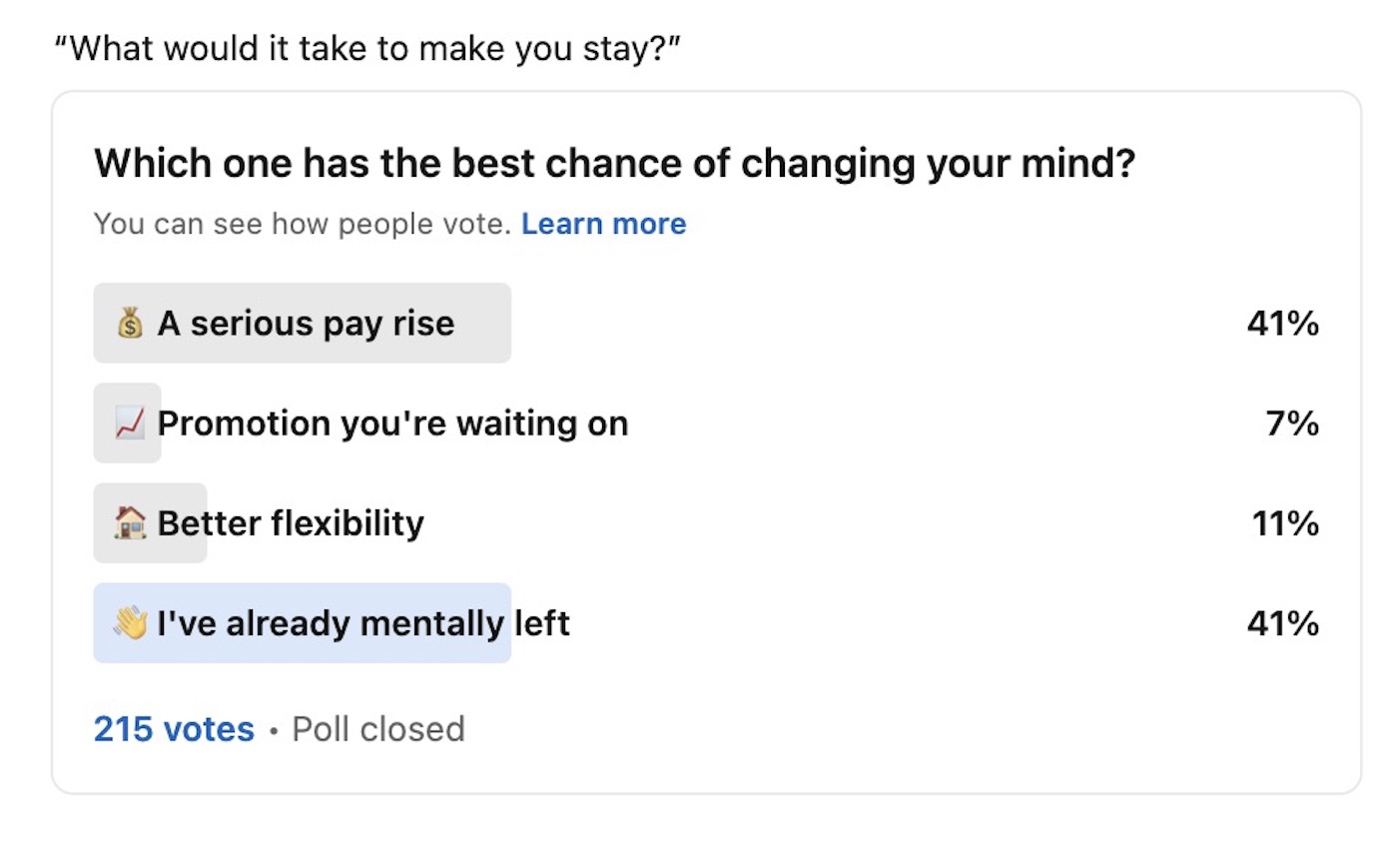
We wanted to know what actually has the power to change someone's mind at this point, so we asked our LinkedIn network.
Imagine you've accepted a new job and resigned. Your current employer asks what it would take to make you stay. What has the best chance of changing your mind?
215 people voted.
The result was almost suspiciously neat.
41% said they'd already mentally left.
41% said a serious pay rise could change their mind.
Better flexibility attracted 11% of the vote.
And the promotion they'd been waiting for?
Just 7%.
[INSERT STONOR POLL IMAGE]
Source: Stonor Search LinkedIn poll, September 2026. 215 responses.
That 7% caught our attention.
Because promotion is one of the things employers often reach for when someone valuable resigns.
Yet by that stage, for most of the people we asked, the horse appears to have already left the stable, updated its LinkedIn and accepted another job.
Money is different.
Even after someone has interviewed elsewhere, accepted another offer and resigned, our poll suggests a serious enough pay rise can still make them think twice.
Which brings us back to confidence.
People accept counteroffers for all sorts of reasons, but salary and the security of staying somewhere familiar can be particularly persuasive when changing jobs feels risky.
Counteroffers aren't unusual either.
CIPD research found that 40% of UK employers had made a counteroffer during the previous 12 months. Of those employers, 38% matched the employee's new salary and 40% offered even more.
Now imagine the decision from the candidate's side.
One option means leaving colleagues they know, giving up the reputation they've built, starting again with a new boss, entering probation and taking a chance that the new company is everything they hope it is.
The other involves turning up at the same desk on Monday.
Except now they're paying you considerably more to sit at it.
You can see why the decision gets harder.
That's why we don't think this is purely about counteroffers.
It's about what the counteroffer does to the perception of risk.
In a confident jobs market, perhaps you back yourself and make the jump.
When things feel uncertain, another £5,000 or £10,000 attached to the security of somewhere you already know can become extremely persuasive.
Not necessarily.
There. We said it.
Recruiters have traditionally been rather fond of telling people never to accept a counteroffer, normally accompanied by a terrifying statistic about how everybody who does will apparently be unemployed by Christmas.
Career decisions aren't that simple.
If you genuinely like your company, enjoy the work and your main frustration was salary, a counteroffer might solve the problem.
Perhaps circumstances really have changed. Maybe an internal opportunity has become available that didn't exist before. Staying can absolutely be the right decision.
We think there's a better question to ask:
If you've been asking for more responsibility and you're finally offered it, that's worth considering.
It's also worth wondering why it took a resignation to make it happen.
If the problem was your manager, another £5,000 probably hasn't changed your manager.
If you felt you'd stopped learning, a new title doesn't necessarily fix that.
If progression has been promised several times before, another promise deserves at least a little scrutiny.
A counteroffer can make staying more attractive.
It doesn't automatically make staying better.
This is where hiring managers can understandably get frustrated.
You've run a good process. The candidate seemed engaged. You've offered the salary they wanted.
They've said yes.
Then they withdraw.
It's tempting to conclude that they were never serious.
From what we're seeing, we don't think that's always fair.
There's a significant psychological difference between talking about leaving a job and actually leaving it.
Before resignation, the candidate is mostly imagining the upside of moving.
The better role. New company. Salary increase. Fresh challenge.
After resignation, they're confronted with what they're giving up.
Their colleagues.
Their reputation.
The manager they know.
The routines they've spent years building.
Then, at exactly that moment, their current employer starts making the case for staying.
The candidate hasn't necessarily become less interested in your job.
The alternative has changed.
That's an important distinction.
This is probably one of the most useful things hiring managers and recruiters can do differently.
Don't wait until you've made an offer to discover whether the candidate is likely to stay where they are.
And don't simply ask:
"Would you accept a counteroffer?"
Most people know what they're supposed to say to that.
Ask this instead:
That's a much more interesting conversation.
Perhaps it's another £10,000.
Perhaps it's finally getting the promotion they've wanted.
Maybe it's two days a week at home.
Perhaps there genuinely isn't anything their employer could offer because the reasons for leaving run much deeper.
None of those answers are necessarily wrong.
They simply tell you more about the decision the candidate is actually making.
The point isn't to interrogate somebody about their loyalty.
It's to understand what you're competing with.
Better to have that conversation during the recruitment process than three weeks after everyone has celebrated an accepted offer.
You can't remove the risk entirely. People change their minds and circumstances change with them.
But employers can reduce the chances of losing a good hire between offer and start date.
The first job is understanding what the candidate is leaving, not merely what they're looking for next.
Then give them enough confidence in the new opportunity to make the move.
Be candid about the business. Let them meet the people they'll actually work with. Explain why the role exists and what success looks like six or twelve months in.
Talk about the company's plans.
Talk about some of the challenges too.
Senior candidates in particular tend to spot a sales pitch fairly quickly.
Certainty is more persuasive than hype.
And once they've accepted, don't disappear.
If somebody has a two or three-month notice period, enthusiastically welcoming them aboard on Tuesday and then going completely silent until their start date probably isn't ideal.
You don't need to love-bomb them.
Just keep the relationship alive.
A note from their future manager. An invitation to a team event. An interesting company update. A coffee halfway through their notice period.
Small things, but they start turning the unfamiliar company into somewhere the candidate can imagine themselves belonging.
Counteroffers tend to be discussed as a recruitment problem.
They're also a retention problem.
If someone is valuable enough to receive a £10,000 pay rise, a promotion and a meeting with the CEO at 4pm on the day they resign, it's reasonable to wonder whether one of those conversations could have happened at 10am the previous day.
By the time somebody resigns, they've normally done quite a lot.
They've thought seriously about leaving. They've updated their CV. Spoken to recruiters. Researched another company. Found time for interviews. Met several people. Discussed salary. Probably talked the decision through at home.
The resignation isn't the beginning of the problem.
It's often the point at which the employer discovers it.
Businesses won't retain everybody, nor should they try to.
But if counteroffers have become a regular part of your retention strategy, there might be an earlier conversation worth having.
We don't think so.
They're becoming more cautious.
That's an important difference.
There are still very good people who want better progression, better leadership, more interesting work, greater responsibility and, yes, more money.
They're willing to listen.
They're willing to interview.
They're willing to get excited about something new.
What we're seeing is that the final jump can feel bigger than employers expect.
And until confidence properly returns to the jobs market, hiring businesses need to recognise what they're actually asking somebody to do.
You're not simply asking them to accept an offer.
You're asking them to give up something they know for something they don't.
The businesses that understand that will have a much better chance of getting great candidates from “yes” to day one.
And for candidates who suddenly find that long-awaited promotion appearing five minutes after handing in their notice?
Consider it properly.
It might genuinely be the opportunity you've been waiting for.
We'd still be tempted to ask where it was on Monday.