June 17, 2026
Three years ago, the following sentence would’ve sounded ridiculous.
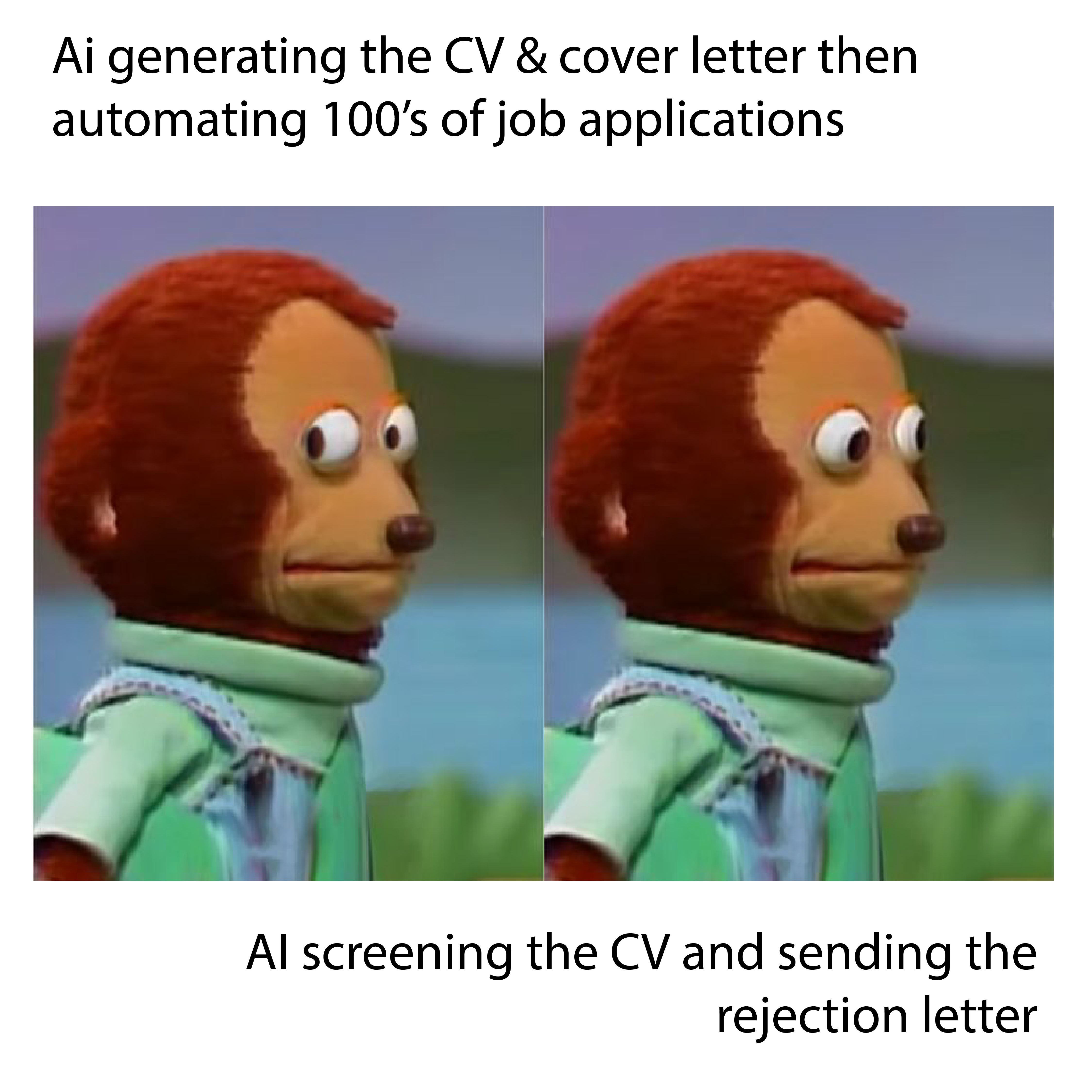
A candidate’s AI agent automatically applies for a job using an AI-written CV, responding to an AI-written advert, before sending an AI-generated message to an AI-powered screening system.
Now, here we are and the whole thing is starting to feel a bit mad.
We’re watching recruitment drift into an arms race where candidates are using AI to get noticed while companies use AI to filter them back out again. Candidates can now apply for hundreds of jobs in a day without really touching the process themselves, while employers are leaning harder into automated screening because hiring managers physically can’t deal with the volume landing in their inboxes.
So now we’ve ended up in a situation where AI writes the advert, AI writes the application, AI screens the CV and AI sends the rejection, all before two actual humans have properly spoken to each other.
That might sound efficient on paper.
In reality, it’s creating a lot of noise and making hiring worse in ways many businesses are only just starting to realise.
Recruiters across marketing, SaaS and tech are seeing application numbers explode, but the increase in volume isn’t really translating into better hiring outcomes.
A huge number of applications are now heavily AI-assisted. CVs are rewritten instantly to match keywords. Cover letters are generated in seconds. Entire job searches can be automated while candidates sleep. On the surface, the applications often look polished and convincing. Then the interview starts and it becomes clear very quickly that the person behind the CV doesn’t always match the version the software created.
That’s becoming a serious problem.
Because the more AI-generated applications flood the market, the harder it becomes to spot genuinely strong people amongst the noise. Businesses respond by introducing even more automated screening to cope with the volume, which pushes candidates to rely even more heavily on AI tools to get through the filters.
Round and round it goes.
And along the way, good people start getting missed.
This is the bit many businesses underestimate.
The strongest candidates are rarely identical copies of a job description. Some brilliant people come from unusual backgrounds. Some undersell themselves badly on paper. Some are exceptional communicators in person but terrible at writing CVs. Some have the raw commercial instinct, emotional intelligence or cultural fit that simply doesn’t show up in a keyword search.
A computer struggles with that kind of nuance.
Humans don’t.
That’s why good recruiters still matter so much, particularly in industries like Marketing, and sales where personality, communication and culture fit genuinely affect performance.
At Stonor Search, we spend a huge amount of time actually speaking to candidates properly because hiring somebody is about far more than whether their CV matches a list of requirements. We want to understand how somebody thinks, what motivates them, what type of environment they thrive in and whether they’ll genuinely fit the culture of the business they’re interviewing with.
A good recruiter knows how to get the best out of a candidate while still keeping the client firmly in mind throughout the process. That’s the real skill. It’s understanding people properly enough to know when somebody will thrive in a business and when they won’t, even if the CV looks great.
That judgement is difficult to automate.
AI absolutely has a place in recruitment.
Used properly, it can reduce admin, improve workflows, help candidates present themselves more clearly and free recruiters up to spend more time doing the valuable part of the job. We use technology ourselves where it genuinely improves efficiency.
What we don’t believe in is handing over human judgement entirely.
Because hiring is still a people decision.
We don’t use AI to scan or reject CVs because we know too much gets missed when recruitment becomes purely algorithm-driven. Often, the very candidates who end up becoming the best hires are the ones an automated system would’ve filtered out immediately.
The irony in all of this is that businesses are trying to save time by automating hiring, while often creating longer processes, weaker shortlists and more bad interviews in the process.
Technology should support recruitment.
It shouldn’t replace the human part altogether.
Because in a world where bots are increasingly talking to bots, the companies that still understand people properly will probably end up with the best hires.